I built a 3D restaurant to practise ordering food in Arabic
A kitchen, a bathroom, a restaurant, and a waiter who only speaks Arabic.
I can tell you the Egyptian word for fridge is تلاجة. You'll forget it by Thursday. That isn't a comment on your memory, it's how vocabulary lists work: a word on a card has nowhere to live. The words that stick are the ones attached to something, usually a place and a moment. The fridge in your grandmother's kitchen. The waiter who corrected your order.
So I built some places. Room Hunt drops you into a 3D kitchen, bathroom or restaurant in your browser and teaches you what everything in it is called, in Egyptian, Levantine, Moroccan Darija or Standard Arabic. Then it sits you down and makes you order dinner.
Four words, then find them
My first version just put you in the room and asked for things. That was a quiz for people who already knew the words, which is nobody on day one. You ended up tapping the toaster, then the kettle, then the fridge, until something lit up.
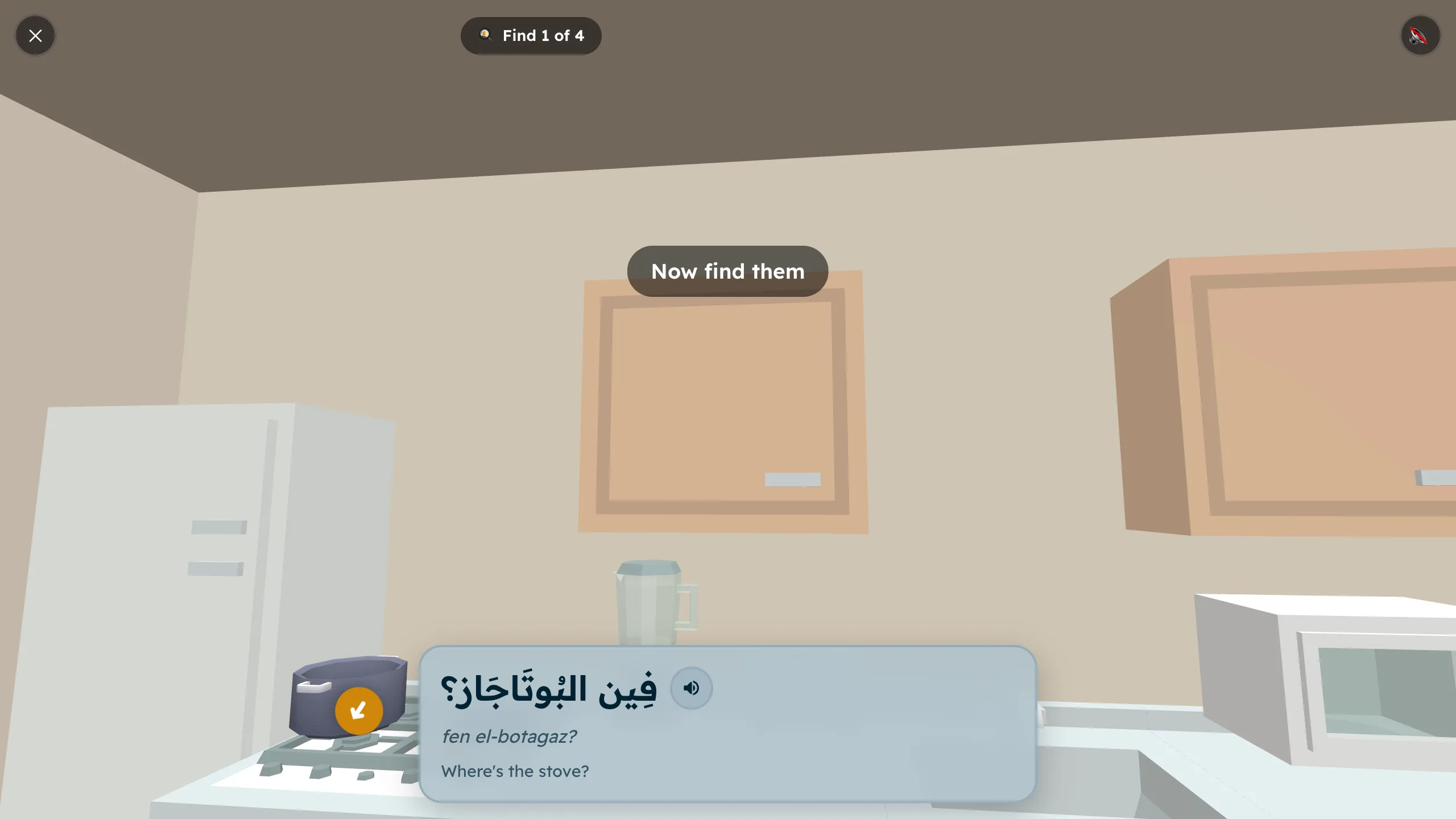
So now each lesson teaches four objects first. The view turns to one, it glows, you hear its name and see it written with the transliteration, and you tap it to move on. Only then does the game ask for them, mixed in with a few words you learned last time.
The question isn't the bare word. It's what someone would actually say to you: فين البوتاجاز؟ (where's the stove?) in Cairo, وين الغاز؟ in Beirut. You learn the noun and the most useful question in the language at the same time, and you hear both, because every word and every question has a recording in each dialect.
The dialects disagree more than you'd guess for a kitchen. The fridge is a tallaga in Egypt and a barrad in Lebanon. The stove is a botagaz in Cairo, ghaz in Beirut and bota in Casablanca. If you've only ever learned the Standard Arabic word, موقد, none of those three kitchens will know what you mean.
Getting it wrong on purpose
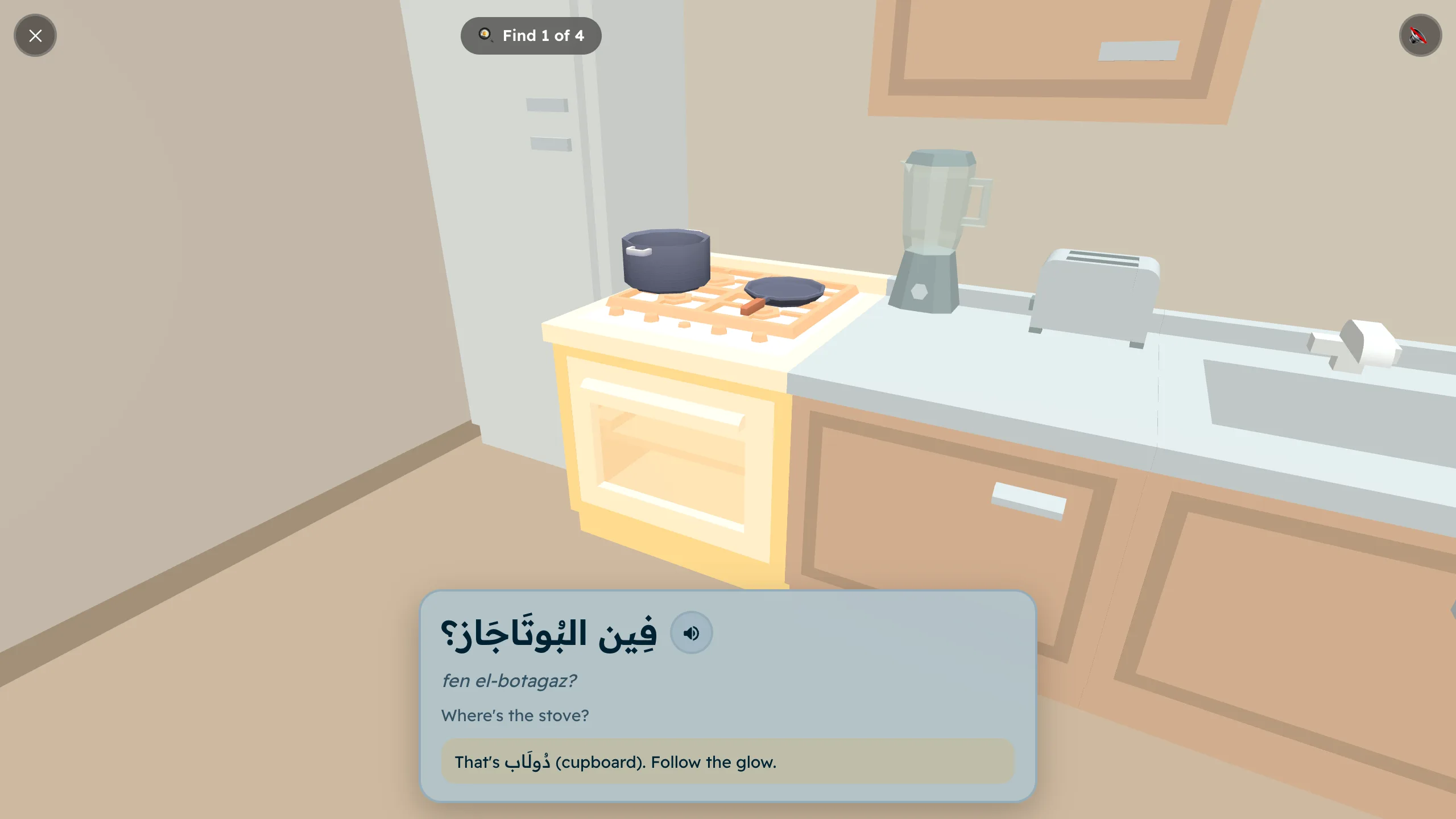
The part I like most is what happens when you miss. Tap the wrong thing and the game tells you what you tapped: "That's دولاب, the cupboard." A wrong answer is still a word. Miss twice and the right object glows amber and the view turns towards it, and that one doesn't earn XP.
Anything you didn't get on the first try comes back three questions later. That's the oldest trick in spaced repetition and it works here for the same reason it works anywhere: you get a second go while the miss still stings a bit.
Once a room feels easy there's a harder mode that flips it around. An object glows and you name it, either by picking from four words or by pressing the microphone and saying it. The speech check compares what it heard with the word, so it cares more about whether you said the right thing than about your accent, which I think is the right way round.
Then the waiter
Finding a fork is fine, but nobody has ever needed to point at a fork in Arabic. What people actually need is the restaurant. So the restaurant has a second mode: you sit down at a table and a waiter walks over from the kitchen.
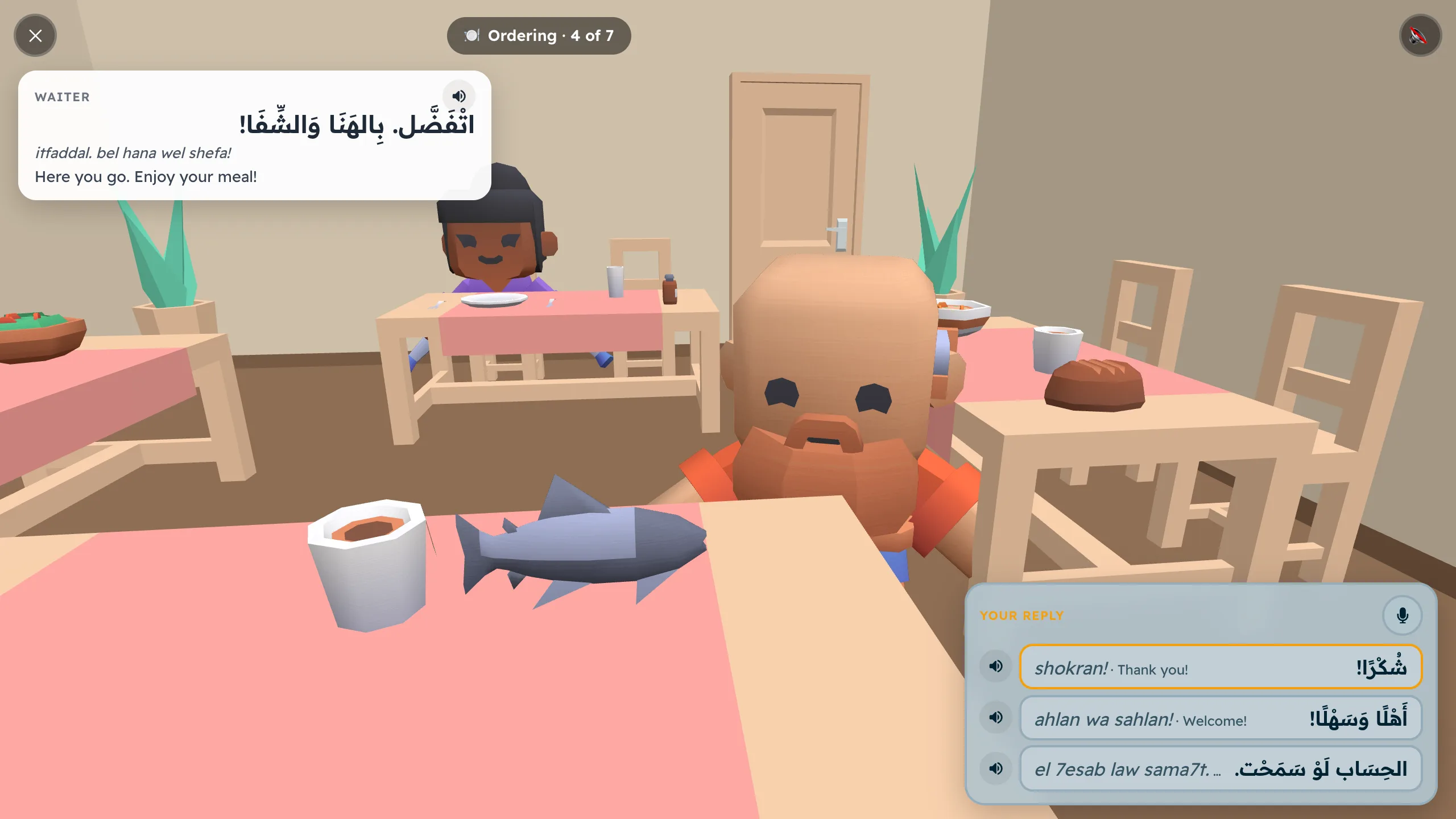
Everything the waiter says appears on screen in Arabic, transliteration and English, and plays in their own voice, which is a different voice from yours so the conversation sounds like two people. You answer by picking one of a few replies or saying it out loud. Your reply is then spoken back in a native voice, so you hear how it should have sounded.
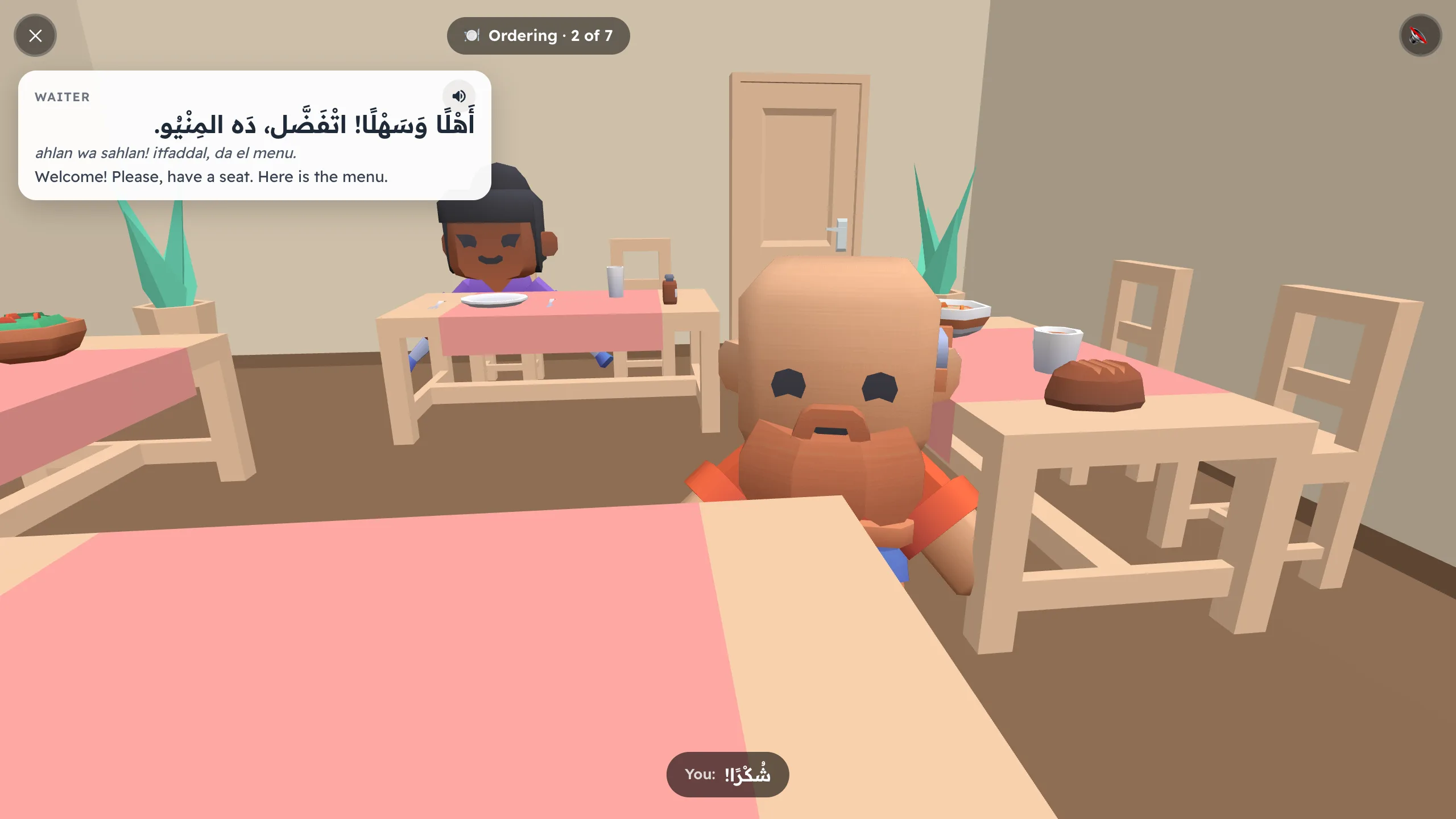
The replies aren't all correct, and that's deliberate. When the waiter welcomes you, one option is "the bill, please". It's perfectly good Arabic and it's the wrong thing to say, so the waiter shakes their head and asks what you mean. I think knowing which phrase fits the moment matters more than knowing the phrase. Most phrasebooks give you the list and leave the timing to you.
Then the waiter brings whatever you ordered. Tea or water, fish, chicken or soup, cake or no cake. They walk to the kitchen, come back, and put it on your table. It's a small thing and it took longer to get right than anything else in the game, but it changes how the choice feels. You aren't picking answer B, you're picking dinner.
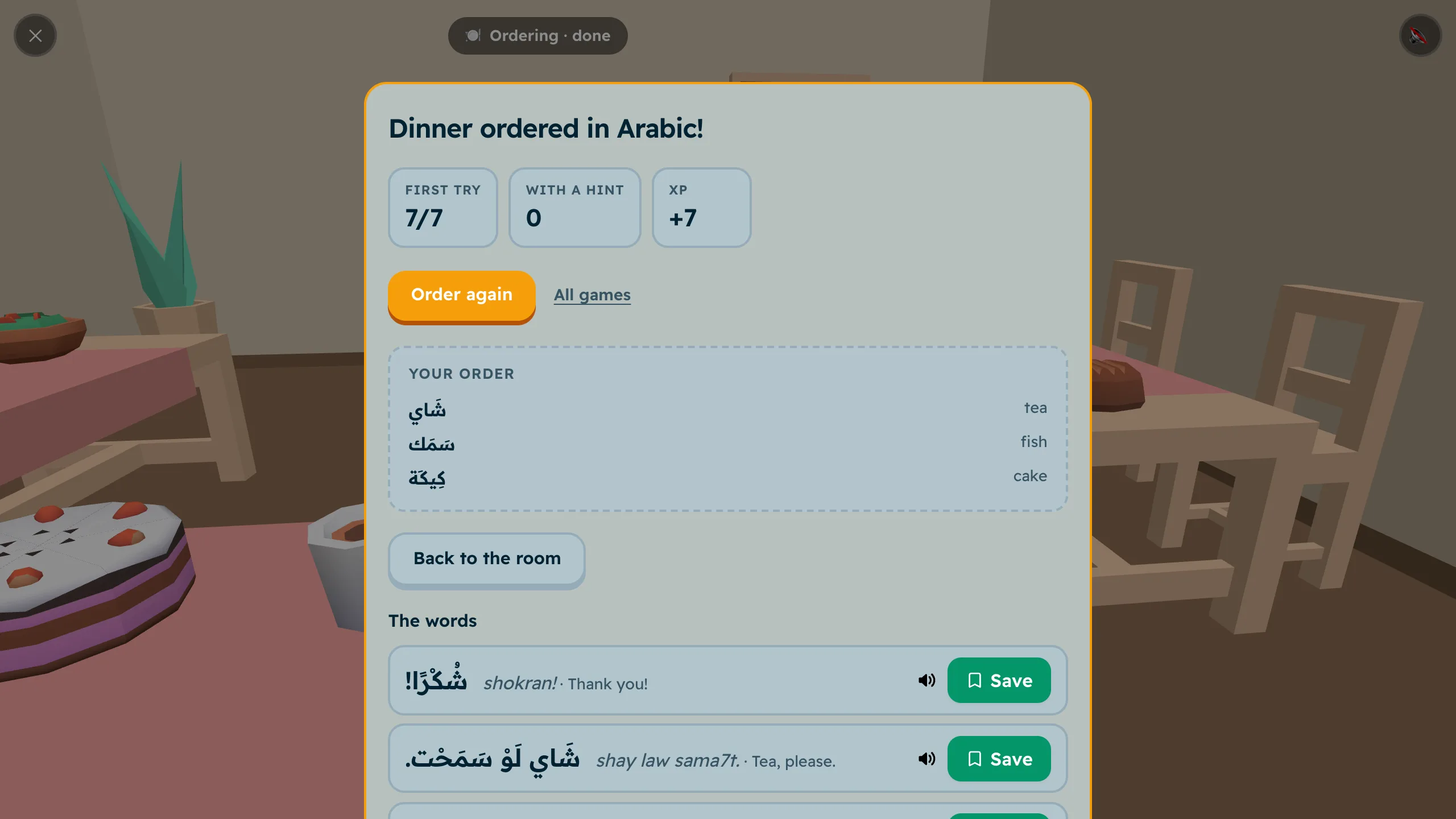
At the end you get the bill, and a receipt of what you ate written in Arabic, and every phrase you used in the conversation with its recording and a button to save it to your review deck. Seven turns, about twenty phrases across the whole scene, two or three minutes.
How it's made, and what's rough
It runs in the browser with three.js, no download. The furniture, food and people are from Kenney's free low-poly kits, which is why everything looks like a well-behaved toy. The recordings are made once per dialect rather than on the fly, so they're instant and free to replay as often as you want.
A few honest caveats:
- The people are from a cartoon kit with enormous heads. Up close the waiter is mostly head, so they stand a polite distance from your table. Characters with more ordinary proportions would help.
- There's one scene so far. Ordering dinner is the obvious first one; a taxi, a pharmacy and a market are the next ones I'd want.
- The waiter's lines are fixed. You choose between replies rather than saying anything you like. For open conversation the tutor is the better tool. This is the rehearsal before that.
Try it
Room Hunt is here, with two free lessons and no account needed. Start in the kitchen, and when the restaurant opens up, sit down and order. There's a longer tour of the features if you'd rather look before you play.