Features · Verb Blitz
Arabic verb drills: every person, every tense
Pick the right form of an everyday verb for a person and a tense, affirmative or negative. 72 verbs with full tables in Egyptian, Levantine, Moroccan Darija and Modern Standard Arabic.
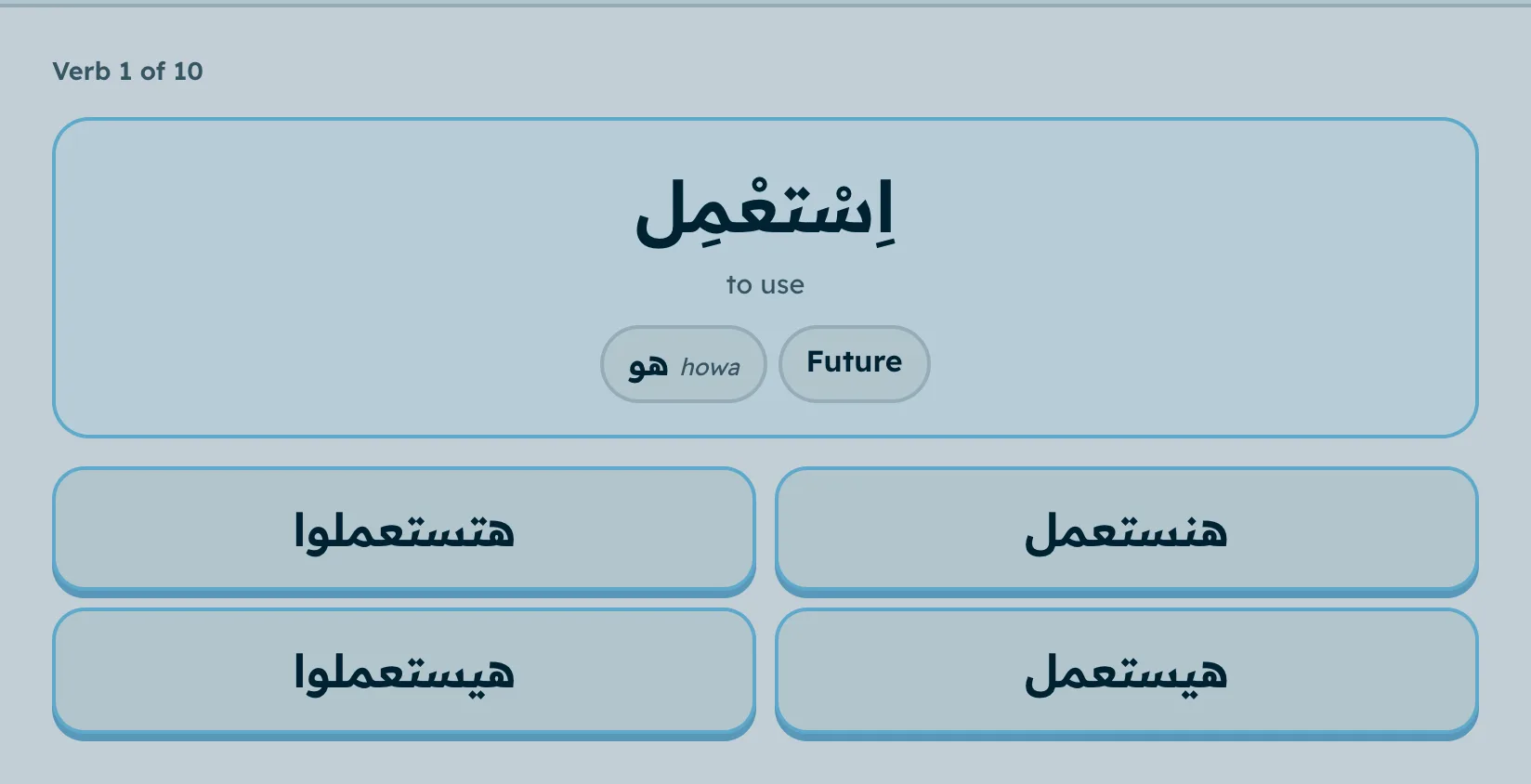
One verb, every person
Each question names a verb, a person (أنا, هي, إحنا…) and a tense. The wrong answers are the same verb for other people or tenses, so you learn the endings and prefixes, not the meanings.
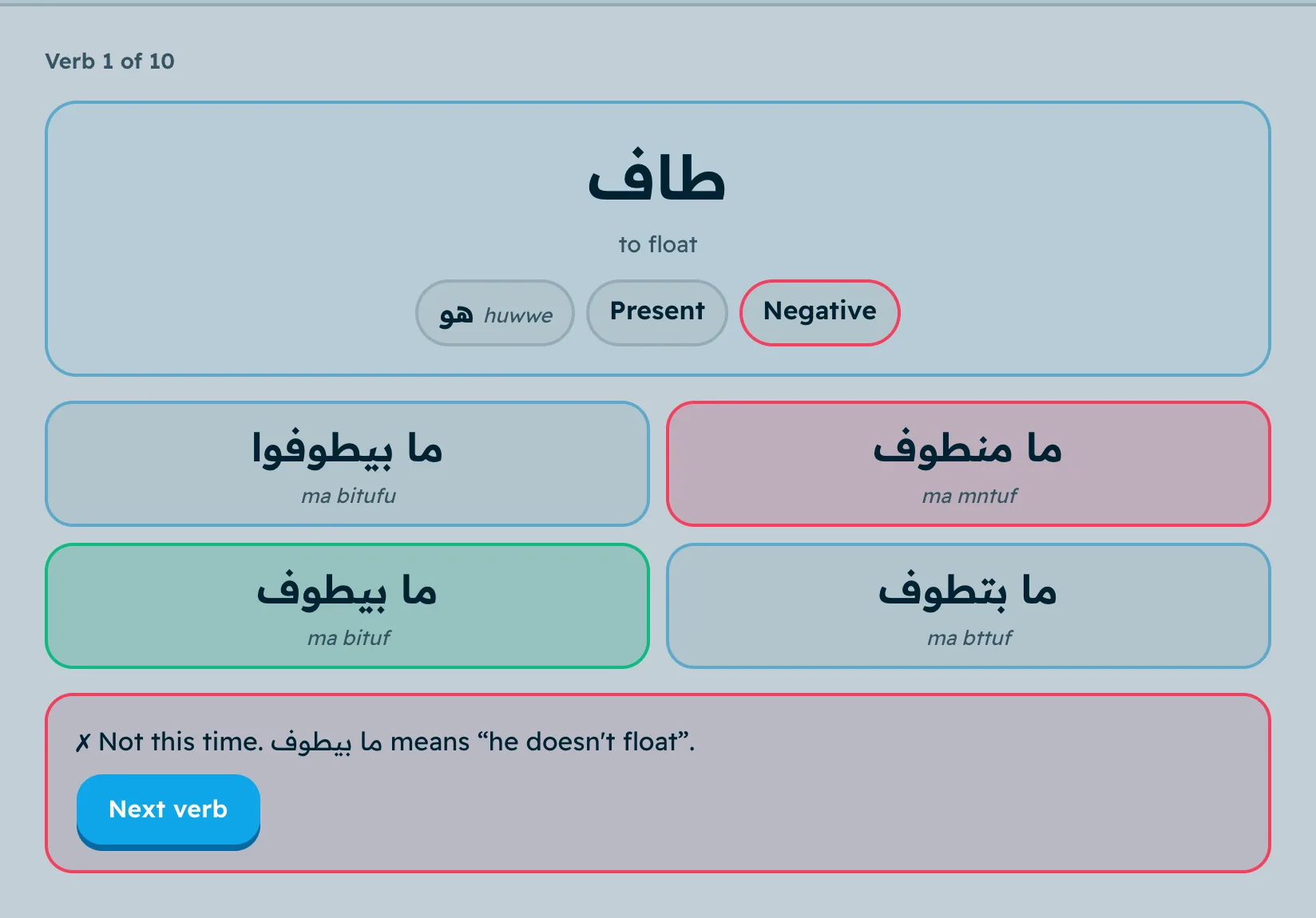
Each dialect’s own markers
The present is بيفتح in Cairo and Beirut and كيحل in Casablanca. The future is ه in Egyptian, رح in Levantine, غادي in Darija and سـ in Fusha. Every dialect has its own tables, not Fusha with an accent.
Negatives too
About a third of the questions are negative: ما…ش in Egyptian and Darija, ما in Levantine, and ما, لا or لن in Fusha depending on the tense.
Common questions
Are Arabic verbs hard to conjugate?
Less than they look. Each tense uses one set of prefixes and endings for almost every verb, so after a handful of verbs the pattern carries you. The irregulars, like "to come", are the ones to learn by heart.
Which verbs are included?
72 everyday verbs, from to be, to go and to come to to apologise for, to compare and to punish, each with past, present and future in the affirmative and negative.
Why does Fusha have vowel marks and the dialects don’t?
In Fusha, "I opened", "you opened" and "she opened" are all written فتحت without them. The marks keep the forms apart. Dialect forms differ in their letters, so they are written the way people text.
Try it in your dialect
Egyptian, Levantine, Moroccan Darija or Modern Standard Arabic. Free to start, no card needed.
More games
- Room Hunt 3D Learn household words in 3D rooms and order dinner from a waiter.
- Games Word scramble, odd one out and more, in four dialects.
- Dialect Match Guess the dialect from a word or a recording.
- Memory Pairs Match Arabic words to meanings or sounds on a card board.
- Speed Round Right or wrong, as fast as you can, for one minute.
- Letter Hunt Recognise every letter in every position, and by sound.
- Listen & Spell Hear a word, choose the spelling. No typing.
- Fill the Gap Pick the missing word in everyday sentences.
- Shadowing Hear a native line, repeat it, get a score.
- Daily Root One root a day: build the words that grow from it.
- Word Scramble Rebuild Arabic words from scrambled letters.
- Odd One Out Four words, one doesn’t fit. Learn why.
- Spot the Mistake One wrong word per sentence. Find it and learn the rule.
- Sentence Scramble Rebuild Arabic sentences from scrambled words.
- Vocabulary Quiz Read, listen or speak your answers.
- Scenarios Nine everyday conversations in 3D, in your dialect.